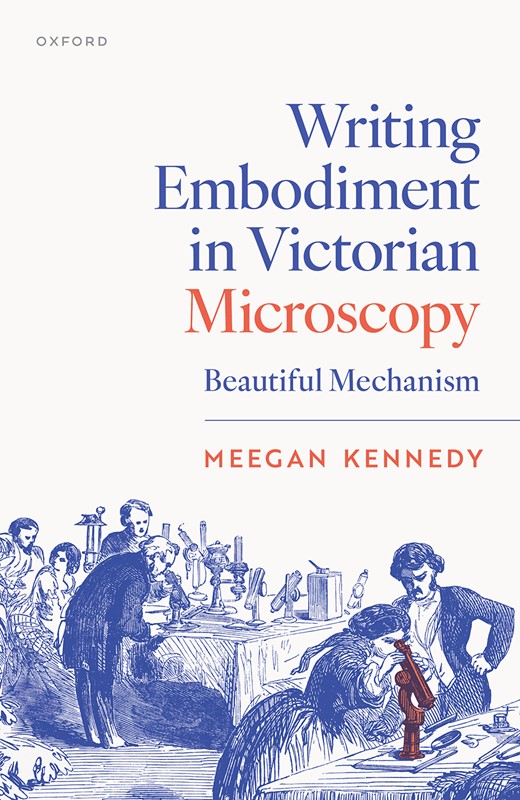
 My most recent book, Writing Embodiment in Victorian Microscopy: Beautiful Mechanism (Oxford UP, 2025) examines Victorians’ skeptical romance with the microscope. Work on this book was supported by an NEH summer stipend, a Huntington-Linacre Exchange Fellowship at Oxford University, an NEH yearlong fellowship, a Dibner Fellowship in the History of Science and Technology at the Huntington Library, and sabbatical and summer funding from FSU. For more information and supplemental materials, click here.
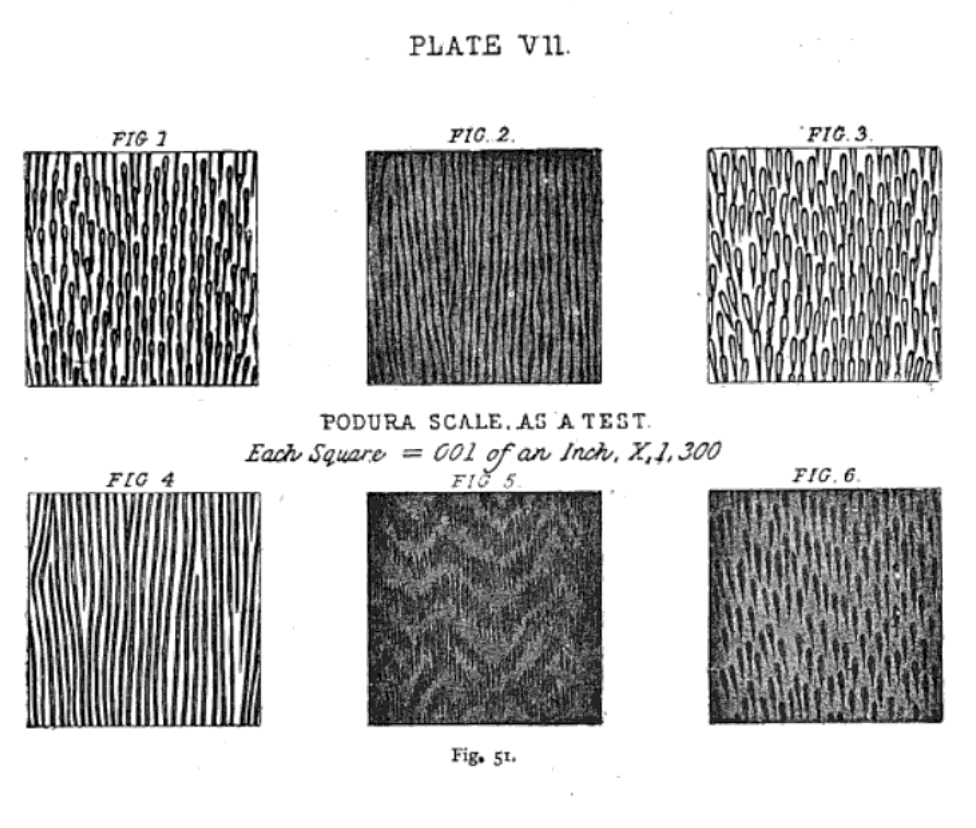 I am currently completing a book titled “Test Objects in Victorian Microscopy.” This book is the second of a planned four-book project examining Victorian microscopy as an intellectual, practical, and social space where questions of sense and representation come to the fore. “Test Objects” focuses on the tiny, difficult-to-see objects that Victorians used to assess the quality of their instruments, in a process adapted from astronomy. (Image of “Podura scale” from Henri van Heurck, The Microscope, 1883).
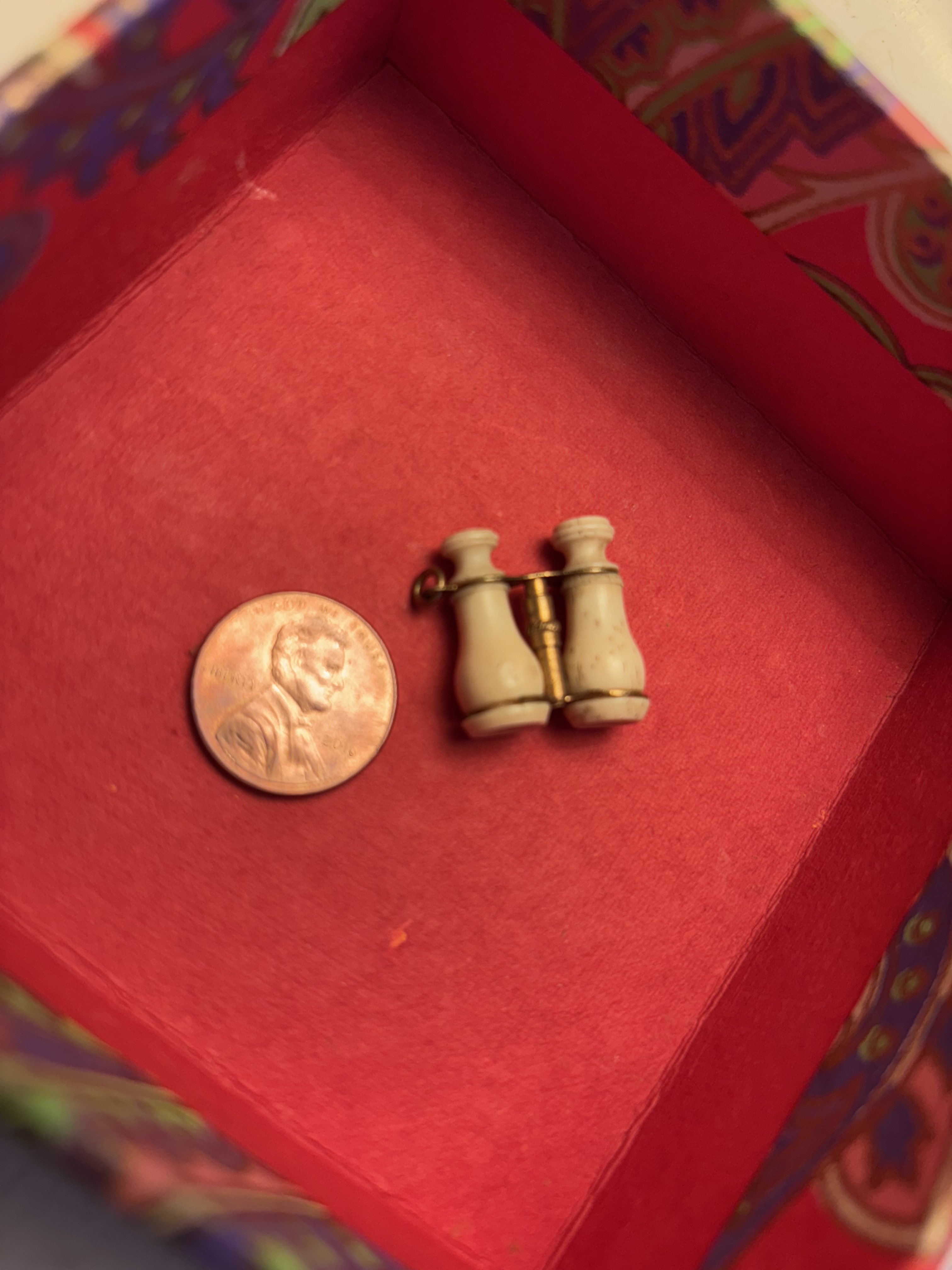 I’m working on essays about Stanhope viewers (optical bijoux), late-nineteenth-century milk-panics, and microscopical periodicals.
I’m also interested in how nineteenth-century British novels and medical texts begin to use and resist visual quantitative narratives, specifically tables, charts, and statistics. Work on this project includes the talk I gave on mediate auscultation at the University of Konstanz, Germany in Summer 2015 and a recent paper on “Oliver as Object” (see below).
With Piers Hale, I am a Series Editor of Routledge Historical Resources: Nineteenth-Century Science, Technology, and Medicine, publication 2023-. This project is a peer-reviewed print and online resource curating an extensive range of Victorian-era primary sources, with critical essays introducing each volume and set. The collection is being published as print volumes and ebooks and will be available in a large online database including these elements, a selection of relevant scholarship from the Taylor & Francis backlist (Routledge, Palgrave, Ashgate, Bloomsbury, Pickering & Chatto, etc.), and new critical essays and videos. The project currently involves 202 volumes spanning 64 topics from 71 contributors. The first commissioned sets were published in 2023; publication is ongoing.
 I published Revising the Clinic: Vision and Representation in Victorian Medical Narrative and the Novel in 2010. The book examines the interplay between medical case histories and British novels from the eighteenth century to the age of Freud. Reissued in paperback in 2017. Open access at link. Click here for reviews.
I am a founding member of FSU’s Health Humanities Initiative (2024).
~~~~~~~~~~~~~~~
Some recent work:
“Water-tigers, Jam-pots, and ‘Ye Mikroskopiker’s Arms’: Boundary-work and boundary objects in comic microscopy,” in Humor Across Victoriana (part of Routledge series, Humor in Literature and Culture), eds. Mou-Lan Wong and James Whitehead. London: Routledge, 2025. When I told a friend that I was writing on nineteenth-century comic microscopy, she quipped, “I can’t see the humor.” Perhaps surprisingly, Victorians working to establish microscopical communities wielded their wit as deftly and variously as they did their lenses.
“Oliver as Object: Character, Genre, and Agency in the Victorian Novel.” Victorian Review 49.2 (2024): 301-20. I’ve always been fascinated by it-narratives, those (mostly) 18th- and 19th-century stories told by objects, whose inadvertent movements through various corners of society often expose the brutality of the marketplace. Here I argue that Oliver Twist plays with this form. How does this change how we read that novel, and “the novel”? For more, see this blog post on the topic.
“Circulation and Civility: Mid-Victorian Botany and Microscopical Method.” In The Victorians: A Botanical Perspective, ed. Luís Manuel Mendonça de Carvalho vol. 1. Cham (Switzerland): Springer Nature, 2024): 131-66. Here I show how matters of character shaped citation patterns amongst mid-Victorian microscopists.
“Diagnosis.” Victorian Literature and Culture, 51.3 (Sept 2023), pp. 383–86. What can the health humanities offer to literary criticism?
“Writing Realism in Nineteenth-Century British Literature and Medicine,” in Literature and Medicine: The Nineteenth Century, ed. Andrew Mangham. Cambridge: Cambridge UP, 2021, pp. 19-37. A guide to the forms and tensions of written realism in two Victorian domains.
“‘Throes and struggles . . . witnessed with painful distinctness’: The oxy-hydrogen microscope, performing science, and the projection of the moving image.” Victorian Studies 62.1 (Autumn 2019 [released March 2020]): 85-118. Many Victorians experienced microscopy not as a research endeavor but as a form of mass-visual entertainment. Here I argue that this helped form a cinematic audience, primed to find fear and sympathy in the projection of moving images on a vast illuminated screen.
“Tono-Bungay and Burroughs Wellcome: Branding Imperial Popular Medicine.” Victorian Literature and Culture 45.1 (2017): 137-62. One of my favorite fictional con-men turns out to overlap in suggestive ways with a titan of the turn-of-the-century pharmaceutical industry.
“‘A True Prophet’?: Speculation in Victorian Sensory Physiology and George Eliot’s ‘The Lifted Veil.’” Nineteenth-Century Literature. PDF available here. Eliot’s strange little fable echoes contemporary reports from neurology and cardiology — a useful reminder that mid-century science could be quite as fantastical as fiction.
‘Discriminating the minuter beauties of nature’: Botany as Natural Theology in a Victorian Medical School,” in Strange Science: Investigating the Limits of Knowledge in the Victorian Age, ed. Shalyn Claggett and Lara Karpenko; forward by Gillian Beer. Ann Arbor: U Mich P, 2016. (Open Access) In medical curricula before the mid-nineteenth century, botany was about much more than plants.
“Open Annotation and Close Reading the Victorian Text: Using Hypothes.is with Students.” Journal of Victorian Culture. October 2016: 1-9. DOI 10.1080/13555502.2016.1233905. Fulltext available here. A practical review. Some of the specifics no longer apply to recent updates of the Hypothes.is annotation software, but the overall questions remain relevant.
“Cleanliness and Medicinal Cheer: Harriet Martineau, the ‘People of Bleaburn,’ and the Sanitary Work of Household Words” in Victorian Medicine and Popular Culture, ed. Louise Penner and Tabitha Sparks. Pickering & Chatto, 2015, pp. 41-51. Currently published by Routledge. Dickens and Martineau team up to propose “cheer” as an important adjunct to epidemic medical care.
~~~~~~~~~~~~~~~
 meegankennedy
You must be logged in to post a comment.